|
26-28 Jan 2026 Grenoble (France)
|
|
|
|
Workshop Agenda & SessionsThis link gives acces to most material related to the workshop, and its content will be updated until and during the event. It contains the book of abstracts, all posters (in "scientific-contributions"), and several other related documents.
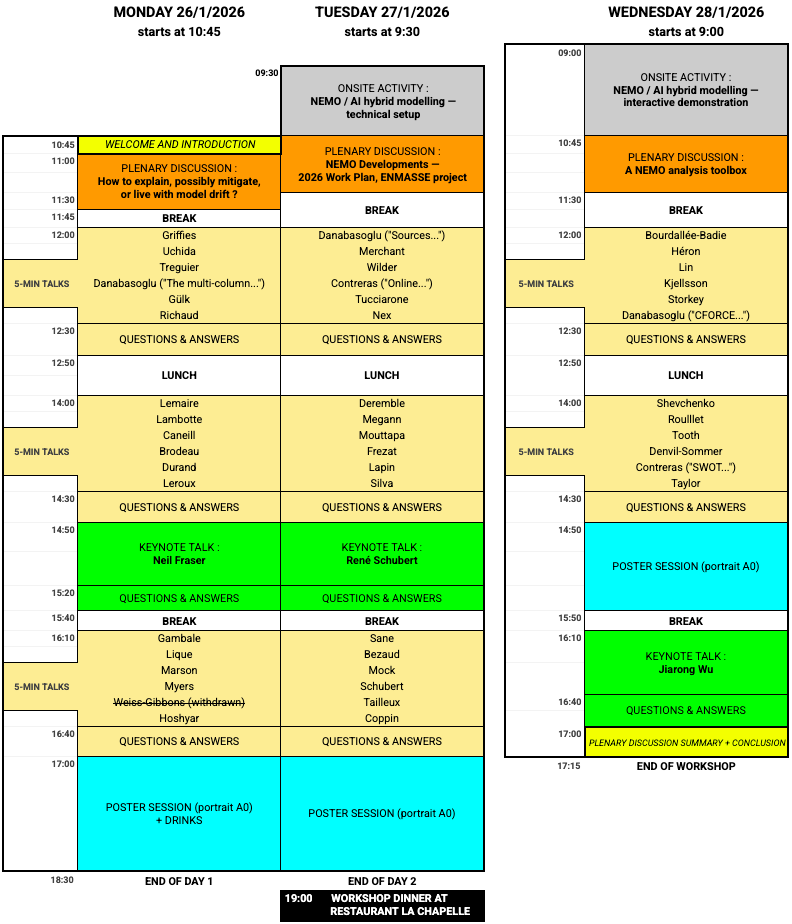
[1] AGENDA On-site participants will be able to participate in all sessions. Due to logistical constraints, remote participants will only have access to Plenary discussions, short talks, and keynote talks via this link: https://videos.univ-grenoble-alpes.fr/live/events/. Registered participants will receive ZOOM links before the event in order to participate more interactively. The agenda below will be complemented with the list of short talks, and may be slightly updated until the workshop. The 5 types of sessions and their content are presented in detail hereafter.
[2] ON-SITE ACTIVITY : days 2,3 (first sessions) A two-stage Hands-on session will be held on Tuesday and Wednesday mornings: during registration, please indicate if you wish to participate, and prepare your computing setup as described just below. NEMO/AI hybrid modelling: technical setup on Tuesday, interactive demonstration on Wednesday (A. Barge, J. Le Sommer) Description: During this interactive session, participants will be invited to build a configuration of the NEMO code which includes a pre-trained machine learning component. Through the OASIS-MCT coupler, they will implement—using the eophis software solution—a use case involving bulk formulas represented as a neural network within a 1D vertical model of the evolution of ocean physical properties at Ocean Station Papa. In practice: The demonstration will be based on eophis: https://github.com/meom-group/eophis/. The demonstration material and technical instructions will be available in this repository: https://github.com/drakkar-workshop/drakkar2026-demo-nemo-hybrid-ml.
[3] PLENARY DISCUSSIONS : days 1, 2, 3 (10:45 - 11:30am) These sessions will be organized and guided by discussion chairs, who will summarize the discussions in the workshop closing session. Themes and schedules will be added to the website. MONDAY : How to explain, possibly mitigate, and live with model drift ? (T. Penduff, S. Griffies) Most ocean and climate model simulations using unassimilated primitive equation models exhibit spurious trends, also called numerical drifts: simulated oceans often tend towards a state that differs from that of the real world, on timescales ranging from a few years for small or shallow domains to several centuries for global simulations. These spurious trends not only bias the final state of simulations: they can hinder or compromise numerical studies of low-frequency variability and geophysical trends (associated, for example, with climate change) observed in the real ocean. Model drifts may potentially come from unbalanced surface or lateral forcings, numerical inconsistencies, incompatibilities between components of model configurations (initial conditions, bathymetry, forcings, parameterizations, …), etc. However, this long-standing problem is not well documented in the ocean and climate modelling literature; we propose to discuss the possible origins and consequences of these spurious trends, accepted practices for reducing them (online or during post-processing) when possible, or for living with them (sometimes at the cost of excluding certain scientific investigations...). TUESDAY : NEMO Developments — 2026 Work Plan, ENMASSE project (P. Mathiot, S. Masson, D. Iovino) --> Please fill out this form as soon as possible so that we can better prepare for this session : https://docs.google.com/document/d/1gWlIYhMaOR7zhupo0E56cJn35Ao1sgK51tlR_bbOtJ8/edit?usp=sharing In this session, representatives of the NEMO System Team and the NEMO Developer Committee will provide an update on ongoing developments and future plans for the NEMO modelling framework, followed by an open discussion:
WEDNESDAY : A NEMO analysis toolbox (S. Griffies, C. Dufour) --> Please fill out this form as soon as possible so that we can better prepare for this session : https://framaforms.org/nemo-diagnostic-tools-session-drakkar-meeting-1765549220 This plenary session aims to discuss strategies for realizing an analysis code environment/toolbox for NEMO simulations. The toolbox is envisioned as a multi-faceted online (e.g., exact budget terms) and offline (e.g., manipulations of budget terms via Python notebooks) suite of diagnostics that facilitates scientific analysis and publications. Examples include a recent project developing water mass transformation diagnostics for MOM6 simulations that can be used as a starting point for NEMO. This experience suggests that a successful analysis toolbox is optimally realized via close collaborations between code developers (those focused on the dynamical core, parameterizations, optimization) and code users (students, postdocs, researchers), with a nonzero overlap between these groups. Results from a survey of the broader NEMO community will be summarized concerning diagnostics presently available for NEMO (both online and offline), as well as those that could be included on a prioritized wish list. The aim is to offer seeds for an organized and vigorous effort to realize a community of active users and developers of NEMO analysis code and use cases.
[4] POSTER & SHORT TALKS SESSIONS : days 1, 2, 3 Poster format: A0 in portrait orientation.
Registered participants will also have access to the PDF versions of all accepted posters about one week before the workshop. We will thus ask by mid January on-site and remote speakers to upload 2 documents (a few introductory slides for short-talk sessions, and the PDF version of their poster). On-site participants will display their physical poster in the venue for one day; remote participants will have their PDF poster available to all registered participants for virtual Q&A.
[5] KEYNOTE SPEAKERS AND TALKS : days 1, 2, 3 Three young scientists will present their recently published work during 25-30min keynote talks followed by 20 min of questions&answers (Q&A). MONDAY : Neil Fraser (Scottish Association for Marine Science, UK). Vertical velocity dynamics in the North Atlantic and Implications for AMOC. The Atlantic meridional overturning circulation (MOC) is traditionally monitored in terms of zonally integrated transport either in depth space or in density space. The near-equivalence of the depth- and density-space MOC in the subtropics suggests that vertical and diapycnal volumes transports are intimately coupled, whereas the divergence of these two metrics at higher latitudes indicates that any such coupling is neither instantaneous nor local. Previous work has characterized the surface buoyancy forcing and mixing processes which drive diapycnal volume transport. Here, we develop a new analytical decomposition of vertical volume transport based on the vorticity budget. This analysis highlights the roles of 1) relative vorticity advection for the sinking of overflow water at the northern subpolar North Atlantic boundaries and 2) the geostrophic β effect for the sinking of dense waters in the intergyre region. We find that vertical transport associated with surface Ekman pumping dominates observed MOC variability, and that the resulting adiabatic isopycnal heave largely explains the lack of meridional coherence in the observed AMOC. Finally, we explore how using an alternative vertical coordinate which accounts for barotropic vortex stretching can provide further insights into the coupling between density- and depth-space MOC metrics. https://doi.org/10.1175/JPO-D-23-0229.1 TUESDAY : René Schubert (GEOMAR, Germany). The ocean flows downhill near the seafloor and recirculates upward above. The ocean’s circulation redistributes heat, salt, biota, dissolved gases, microplastics, and sediments on Earth. The abyssal ocean, in the lowest 1000 m above the seafloor, moves on average with the deeper seafloor to its left in the Northern Hemisphere and to its right in the Southern Hemisphere. This finding has received little attention and its consequences for the abyssal vertical circulation have remained largely unexplored. Here, we show, using current-meter measurements and numerical simulations, that the interior flow, O(100 m) - O(1000 m) above the seafloor, is deflected within the bottom boundary layer, the lowest O(10 m), into a widespread downhill flow. This flow intensifies with the steepness of the seafloor. We further reveal that typical local changes in seafloor steepness lead to a shallow divergence and a deep convergence of this downhill flow. These are connected by an overlying upward recirculation forming closed overturning cells that extend on average over the lowest 1000 m of the ocean. Finally, the effects on the abyssal buoyancy budget are discussed. As oceanic overturning is climate-relevant, our study highlights the need to better understand the associated dynamics, to identify its impacts, and to implement these impacts into climate and Earth system simulations. Furthermore, the effects of widespread near-bottom downwelling on sediments, microplastics, chemicals and biota need to be investigated in the future. doi.org/10.1038/s41467-025-61027-2 WEDNESDAY: Jiarong Wu (Courant Institute of Mathematical Sciences, USA). Air-sea flux parameterization — A data-driven approach and its online realization. Accurately quantifying air-sea fluxes is important for understanding air-sea interactions and improving coupled weather and climate systems. This study introduces a probabilistic framework to represent the uncertain nature of air-sea fluxes. Assuming Gaussian distributions conditioned on the input variables, we use artificial neural networks and eddy-covariance measurement data to estimate the mean and variance by minimizing negative log-likelihood loss. The trained neural networks provide alternative mean flux estimates to existing bulk algorithms, and quantify the uncertainty around the mean estimates. Stochastic parameterization of air-sea turbulent fluxes can be constructed by sampling from the predicted distributions. I will discuss test results first in a single-column forced ocean model and then in a coupled CESM historical configuration. https://arxiv.org/abs/2503.03990 |